Seller + buyer experience · 0→1
Mystery Box
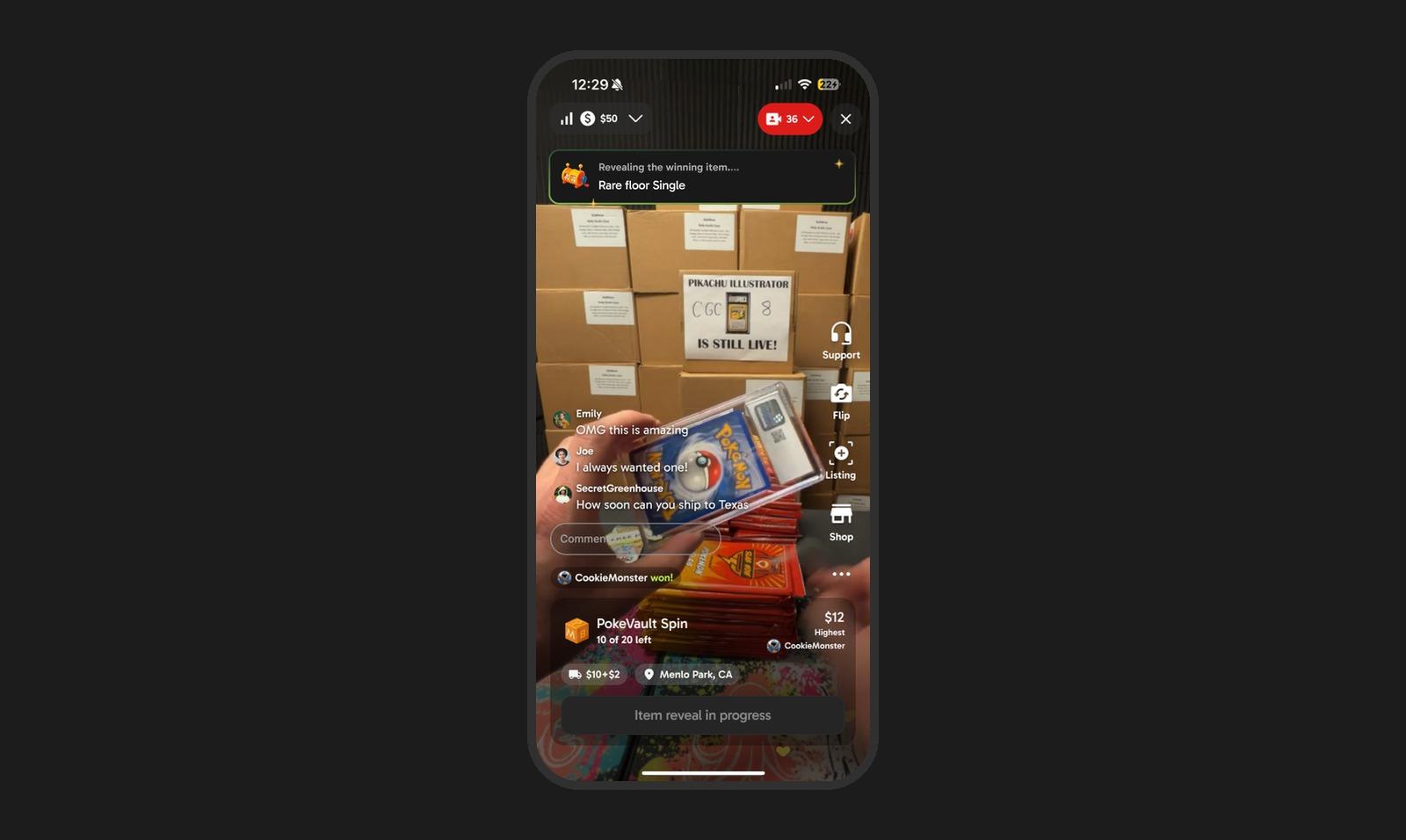
A gamified way to sell on LIVE. The seller lists every item that could be in the box and marks the best ones as hot items. Buyers bid, and each winner gets one item picked at random, so nobody knows what they got until the reveal.
Why: Palmstreet had no game style way to sell, and some top collectibles sellers were holding off on joining because of it. Sellers told us games lift their sales per hour and keep viewers watching, so we built an MVP to bring the thrill of a blind box to LIVE, with fairness built in.
My role: Designed Mystery Box for sellers and buyers across web and mobile, from V1 through Quick Spin and Hold the Mystery.
I also created the original Mystery Box branding, which other designers later built on for future updates.
Outcome
In ten months, Mystery Box went from a LIVE-only experiment to one of Palmstreet’s biggest ways to sell.
- of platform GMV, up from 0.4% at launch
- of all orders, up from 0.5%
- of buyers bought a box, up from 1.3%
- more boxes sold per month
- new boxes use Quick Spin, two months after it launched
Launch month vs. ten months later, for the whole format.
MVP: Buy and reveal during a LIVE, with a wheel-spin animation and a list of what can be inside.
2025–2026 · 5 phases · Shipped · Web and mobile
Seller + buyer experience · 0→1
Buyback
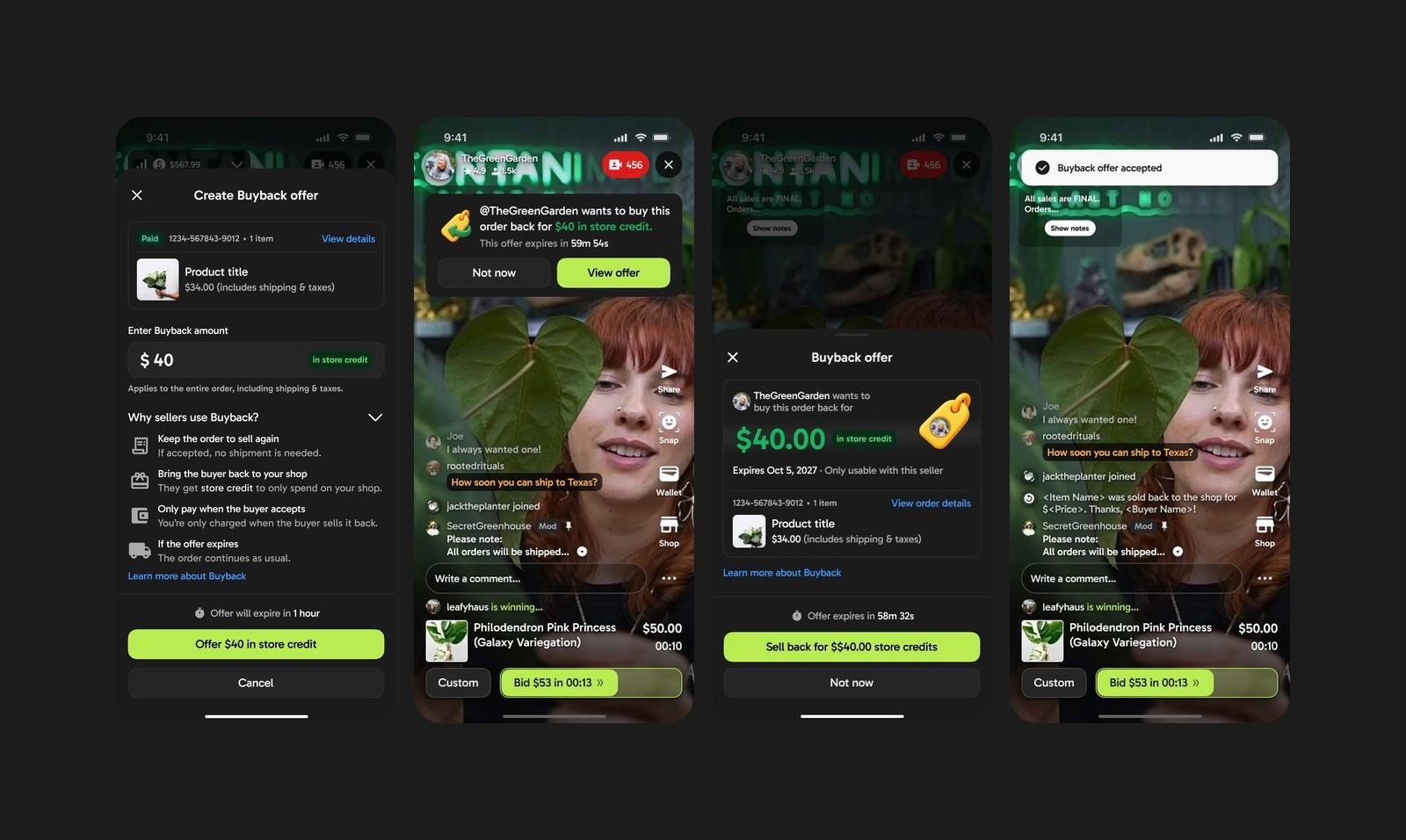
A way for sellers to buy back an item they just sold, before it ships, so buyers aren’t stuck with things they don’t want.
Why: We spotted the need by talking to sellers. Collectibles and Disney sellers especially were already buying items back themselves, offering store credit as coupons.
How it works:
- The seller sends an offer on a sold item.
- The buyer accepts, or lets the offer expire.
- If they accept, they get credits to spend with that seller, and the item stays with the seller to sell again.
My role: Designed the full journey, 0→1, for buyers and sellers. Offers can be sent during a LIVE or after it, so it touched LIVE, messages, notifications, order management and order receipts.
Seller
Buyer
2026 · Designed in under 3 weeks · Coming soon · 1 UX, 1 PM, 5+ stakeholders
Seller + buyer experience · 0→1
LIVE Break
A new way to sell trading cards on LIVE, and the main way cards sell on live shopping apps.
Why: Card sellers were already on Palmstreet, but without Breaks built in they worked around it with Mystery Box. Some sellers told us they needed Breaks before they'd switch over from a competitor.
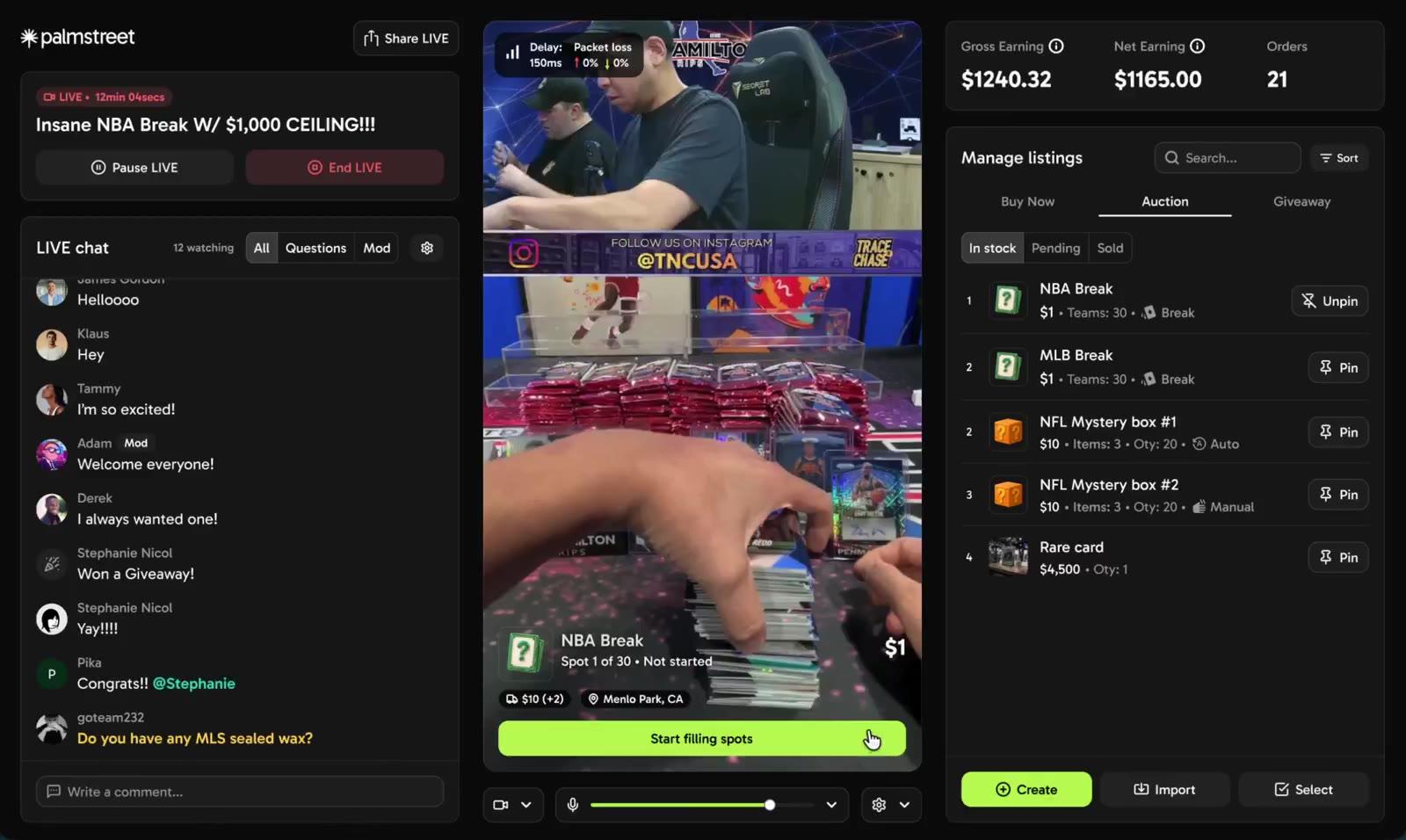
How it works: A seller creates a Break with a spot for each team, and it runs in three steps:
1. Filling spots: Buyers buy spots, and each spot is randomly matched to a team.
2. Breaking: Once every spot is sold, the seller opens new packs and assigns each card to the buyer who has that team.
3. Ending: The seller shows all the cards everyone won and ends the Break.
My role: I led this 0→1 project end to end. I studied how other live shopping apps run Breaks to understand how card breaking works, then went through several rounds of iteration for defining our MVP and edge cases (like using the Palmstreet randomizer vs a custom one, and clearing assigned teams for sold spots).
I also created the Break branding, using ChatGPT for the illustrations and Gemini for the reveal animation.
Why desktop first: Card sellers go LIVE with OBS on desktop, so we met them there and built the MVP in Seller Hub.
Seller setup: Before going LIVE, the seller creates a Break, picks a team list like NBA teams or adds their own, and gets a spot for each team.
2026 · Designed in 3 weeks · Shipped · 1 UX, 1 PM, 5+ stakeholders
Seller experience · 0→1
Seller Hub LIVE
Desktop LIVE for sellers, so they can run their shows from a computer, not just their phone.
Why: Running a show on a phone is hard. Sellers struggled to read comments, manage listings and add products on a small screen, and our data showed more of them moving to desktop. So we brought LIVE to desktop, with everything sellers could already do in the app.
Timeline: Design took about two weeks for each phase: Phase 1 (Jan–Feb 2026), Phase 2 (Jun–Jul 2026) and Phase 3 (Aug–Sep 2026).
My role: I led Seller Hub LIVE as a 0→1 product, working closely with the PM and CTO, and shipped it in three phases. After the first phase, I moved every component over to the shadcn/ui library, which we adopted halfway through, so the whole product stayed consistent.
Outcome
Sellers picked it up fast. Five months after launch, nearly 1 in 5 LIVE shows on Palmstreet were run from Seller Hub LIVE.
- of all LIVE shows run from desktop, 5 months after launch
- of active sellers now go LIVE, up from 52%
- of Palmstreet's sales (GMV) happen in LIVE shows
The last two are Palmstreet-wide LIVE numbers, the business Seller Hub LIVE supports.
MVP: Streaming from desktop, viewing comments and OBS support.
2026 · 3 phases · Shipped · 1 UX, 1 PM, 4+ stakeholders
Buyer + seller experience · Redesign
LIVE redesign
A cleanup of the LIVE room for buyers and sellers.
Why: Features added over time had made the room feel busy. We wanted one consistent place for every widget, so buyers and sellers always know where to look.
Multi-widget: My idea to replace the scattered widgets. Sellers add notes, coupons, giveaways or their next LIVE from one menu, and buyers see it all in one card that rotates through each.
Bottom half of the LIVE: Worked on cleaning up the listing and comments, improving the typography, readability, spacing and icons across every product state.
My role: Designer for the redesign, design-led from start to finish. It shipped in phases over a long stretch, with each one taking under a week of design before handoff to engineering.
Before
After
2025–2026 · Shipped in phases · Under a week of design each · Design-led
Buyer experience · 0→1
Shopping cart
Palmstreet's first shopping cart, so buyers can check out several items from the same shop at once.
Why: Buyers had to check out one item at a time, with a separate payment and shipment for each. Buying more than one thing was a chore, which held back order value.
MVP: The cart, live stock checks so one-of-a-kind items don't oversell, shipping per shop, and checkout with notes and gift options.
My role: Solo designer for the whole cart experience, including entry points across the app.
Outcome
Buyers pay once and track one order, and sellers get one order instead of many.
- more multi-item orders than before the cart
- the order value (AOV) of a single-item order
Jul–Aug 2025 · ~1.5 weeks · Shipped, live now · 1 UX, 1 PM, 2 eng
Buyer experience · SEO
Web marketplace
Palmstreet's web marketplace and product pages, redesigned so one-of-a-kind listings get found through search and convert once shoppers land.
Why: The old pages had no SEO structure, so few shoppers found Palmstreet through search.
Outcome: Shipped a marketplace page with search, filters and sorting on desktop and mobile. Product pages now lead with what search engines read, like clear titles, descriptions, reviews and FAQs, plus similar items and a sticky Buy now button on mobile.
Compare
Jul 2025 · 1 week · Shipped · 1 UX, 1 PM, 1 Dev, 3+ stakeholders
Brand & growth
2025 Year in Review
A personalised recap of 2025 for buyers and sellers, celebrating each person's year and the community around them.
Why: A growth opportunity. A recap people are excited to share puts Palmstreet in front of their friends and followers, and gives our community a reason to celebrate their year.
For sellers: The day their business took off, LIVE shows and purges hosted, new followers, their top three fans, their longest, most-loved and best-selling LIVE, and orders fulfilled across the US, with where they rank among sellers.
For buyers: Their first day on Palmstreet, LIVE shows joined and comments shared, days on the app, their favourite sellers, and how many sellers they supported across the US.
The live version is animated in code; the recording here shows the static frames I designed.
Outcome
The win was reach: far more people opened their recap than in 2024, and they shared it just as often.
- more shares than the 2024 recap
- more people shared their recap
- shares per recap opened, steady with 2024
View as
Nov 2025 · Under 2 weeks · Shipped · 1 UX, 1 Dev · Design-led, no PM
Buyer + seller experience · LIVE
LIVE tools
Smaller features that make LIVE shows easier to run and nicer to watch.
Why: Most of these came from seller feedback about what got in the way during a show.
2025–2026 · ~3–4 days of design each · Shipped
Buyer experience · Growth experiment
Streaks
A growth experiment: watch any LIVE for 3 minutes a day to build a streak.
Why: Improve retention. Bring buyers back daily to watch more LIVEs, which we hoped would lead to more sales, and get streaks shared with friends and on social media.
What happened: It didn't resonate, and people asked to opt out. Palmstreet is a place to shop, and a streak felt like a social feature. We added an off switch, made it less prominent, then sunset it.
What I learned: Not every experiment wins. Check that a feature fits why people come to the product, and always give them an easy way to opt out.
These screens are from a later iteration we mocked up, including a leaderboard that was never built.
State
2026 · Growth experiment · Shipped, then sunset
Buyer experience · Discovery
Feed, Shop and Explore tabs
Redesigns of the three tabs buyers browse.
Why: Most of Palmstreet's sales happen in LIVE shows, so the Feed's job is getting buyers into one, and we redesigned it to surface a wider range of shows. Shop and Explore were used far less, looked outdated and didn't follow our design system, so we refreshed them to make the whole app feel stronger.
Feed tab outcome
The feed now shows buyers a far wider range of LIVE shows, without showing more cards.
- more different LIVE shows shown in the feed, on a similar number of impressions
- more viewers reached
- feed impressions turns into someone joining a LIVE
Year over year.
2026 · ~3–4 days of design each · Shipped
Buyer + seller experience · Refresh
Login and messages
Two everyday screens, cleaned up.
Login: Palmstreet started with plants, and the old screen still looked that way. It was outdated and didn't follow our design system. The new sign-up screen shows the range of categories Palmstreet sells now and leads with the sign-up coupon.
Messages: One of my first projects at Palmstreet. Messages were hard to read, so I redesigned them for better accessibility, with clearer chat bubbles, avatars and stronger contrast.
Before
After
2025 · ~1–2 days · Shipped
Brand · Physical products
Brand and merch
Beyond the app, I designed merch to help grow Palmstreet as a community brand.
Nibbs plushie: The characters came from our weekly LIVE trivia game, each with a personality that fit how people played. I explored soft toy versions with ChatGPT image generation. Nibbs launched as a limited run and sold out.
Totes: Illustrated totes sold as Palmstreet merch. The plants design was picked from my concepts.
Merch · Totes on sale, Nibbs plushie sold out